Composing dream spaces
by Neil Luck
Six months after finishing Whatever Weighs You Down (WWYD) for Zubin Kanga, in 2022, I had my first encounter with the work and writings of the brilliant filmmaker, writer and composer Trinh T. Minh-ha. The Württembergische Kunstverein in Stuttgart hosted an exhibition of several of her films that thrive in unsteady borders between documentary, fiction, autobiography, ethnography and abstractness. I was particularly taken with her digital films which intentionally push against mainstream aesthetics; images are cropped in odd ways, or coloured unnaturally. Artefacts are embraced and expanded upon, fidelities of image and sound are mixed, soundtracks and sound effects are abstract and conspicuous, language is poetic and slippery and confusing. In her book on digital image-making, D-Passage, she describes how her works aim to manifest a “voice”, being:
a site and an activity by which the works social, ethical, and aesthetic positioning is conveyed to the viewer-listener. One can locate it in the intervals between saying and seeing, speaking and hearing, or between language and image, sense and sound.
The mainstream and commercial tendency to produce sound and image in ways that feel real resists the possibility of the multimedia work being one of multiplicities. Media is integrated and folded onto itself rather than intermediated. This is bound up with its means of production too: its hardware and softwares designed specifically to streamline production to an ‘industry standard’.
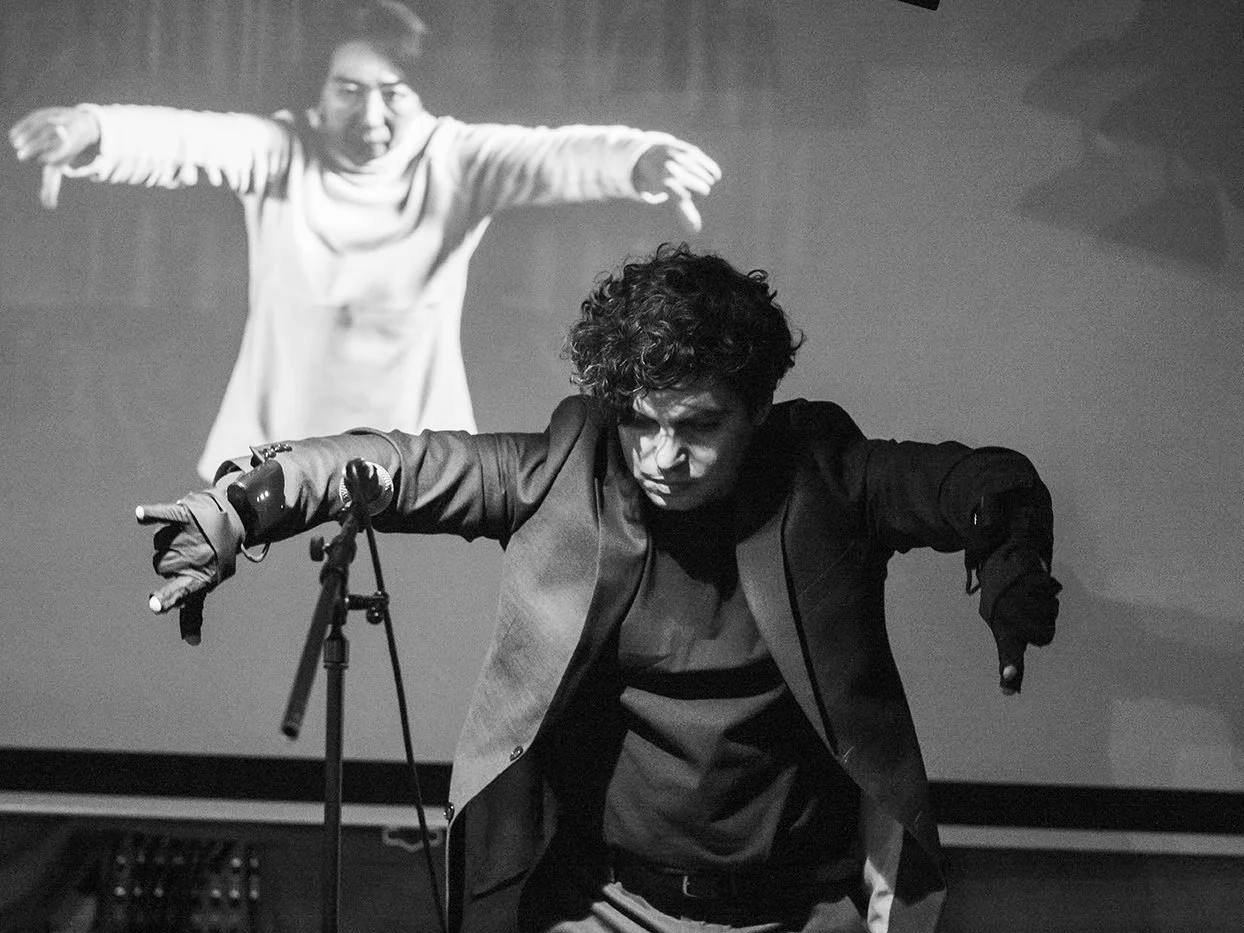
Zubin Kanga performing with MiMU motion-sensor gloves in Neil Luck’s Whatever Weighs You Down with video of Chisato Minamimura. Photo by Sisi Burn
Personally, my interest in digital sound and image technology has always been more about its languages rather than its surfaces (I would never claim to be working at the bleeding-edge of anything!), and so I find myself also drawn to intervals as places that open up space for ambiguity, ambivalence, confusion and projection. In past works, this has manifested through careful and intentional misalignments of sound, image and text, or superimpositions of two or more audiovisual energies. In talking about extending this language with Zubin, languages of ‘accessible’ technology came up early on. Specifically Object-based media was a touchstone; the idea that a radio programme or film could be extrapolated to aid understanding by people with visual or hearing impairments, such as voiceovers, additional spatially realistic sound effects, alternative mixes. In WWYD, then, we worked closely with Deaf performance artist Chisato Minamimura as an onscreen performer. Working closely with Chisato, however, also deeply informed the language of the work itself, raising for me seemingly quite basic, but important and complex questions:
What if the audience can’t understand what’s being signed, or spoken?
What if subtitles and BSL and recorded dialogue are different?
What new meaning might emerge if a non-signing artist works with footage of BSL?
Is it even ok to treat a language like this?
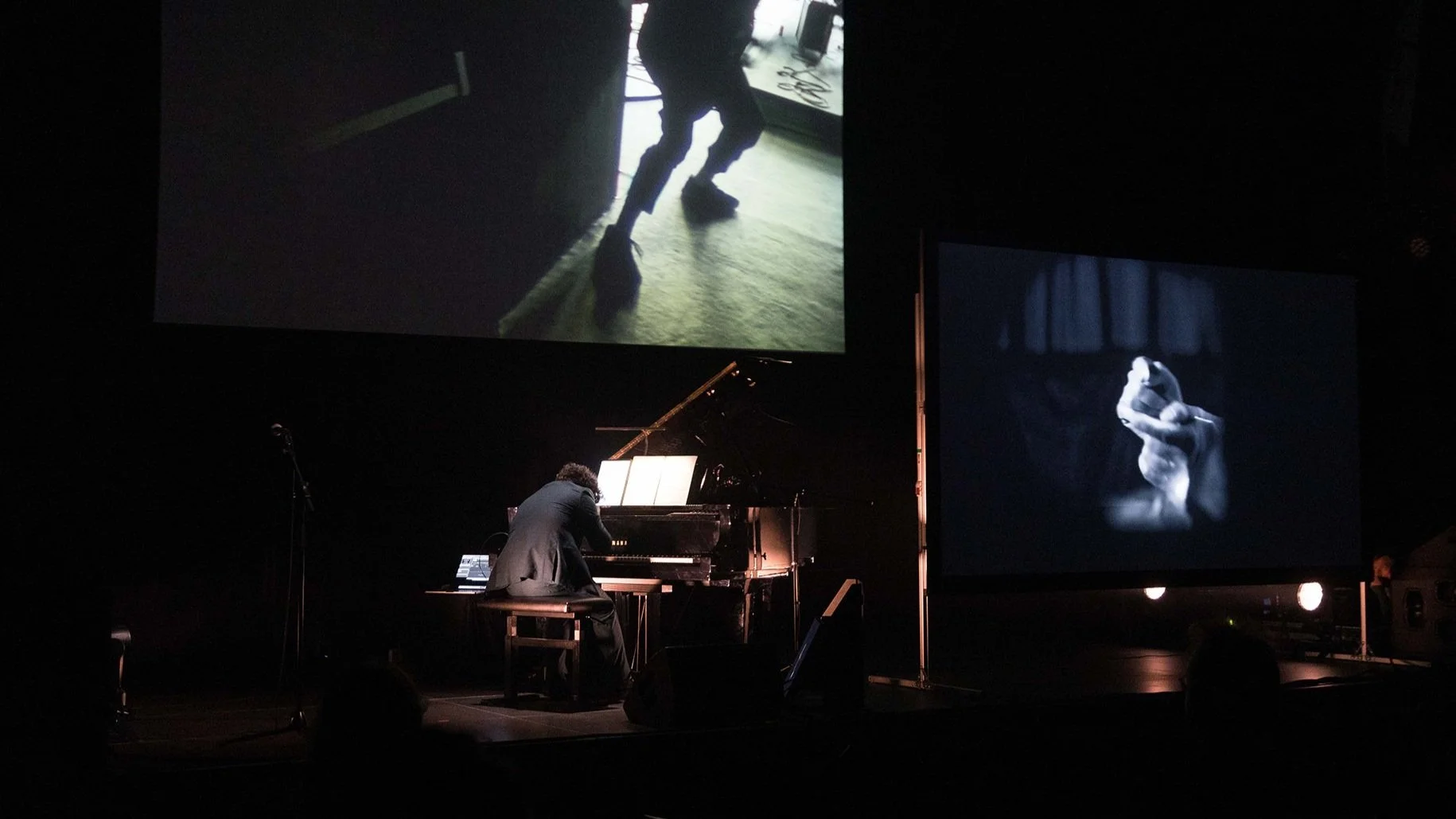
Zubin Kanga performing Whatever Weighs You Down at Gaudeamus, in Utrecht, Netherlands. Photo by Hans Poel
All this plays out in the piece through a dense amalgam of screens, technologies, live acts, recorded acts, and a sort of fractured (across all these surfaces), narrated remembrance of dreams of falling. About halfway through the piece we introduce MiMU Glove technology that allows Zubin to manipulate electronic sounds live with his hand gestures. Much could be said about the detailed technological aspect of integrating new technologies in this way, but for me it was equally important that it served as a kind of symbolic, almost logical connective thread between worlds, characters, surfaces and languages; the seen and heard and read.
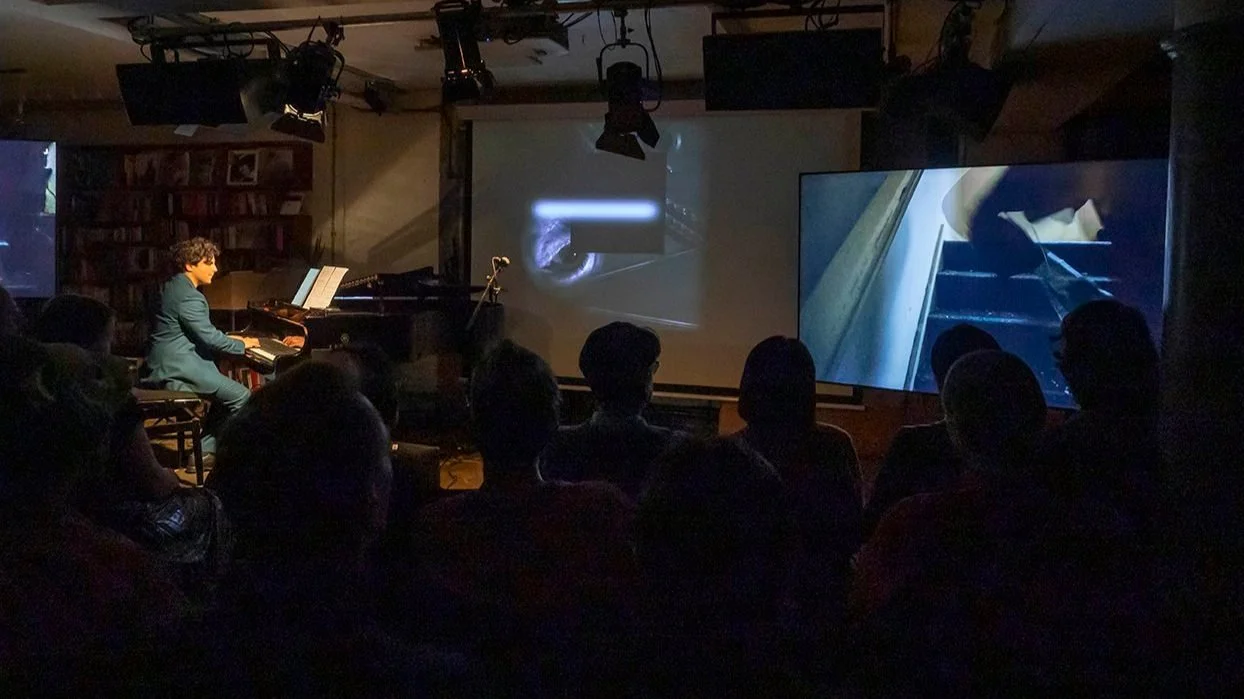
Zubin Kanga performing Whatever Weighs You Down at Café Oto, London. Photo by Sisi Burn
It’s maybe a cliché, but for me much of this does function like dream space where connective threads loosen, layers of media slip around each other and everything is allowed to function like an allegory or symbol. In WWYD, this is pushed pretty far, the whole work feeling like a kind of absence or interval, with very little coming into full focus or stating its concrete presence.
Stepping back once again, in 2017 I had the privilege of spending the summer studying Noh theatre performance in Kyoto. People often talk about this extremely slow, measured, masked theatre as operating like a kind of dream, and indeed audience members often unashamedly nod off during performances. What really stuck with me during my brief exploration was the curious energy generated by the incredibly precise individually memorised material for the dancers, chanters and musicians, that was then brought together with little or no rehearsal and no director. Slippage between independent layers occurs, sometimes connecting, sometimes not. But this is not just a surface aesthetic, it’s folded into the fabric of how a text is articulated and opened up. It promotes a confused, hypnagogic reading by an audience. I find it challenging to watch and found it extremely challenging to perform. I see now (in 2025) that WWYD has taken something from that experience but here using layers of technologies and languages to attempt to conjure a similar space that is more about (to adopt Noh playwright Zeami’s terms) substance than function. I’m very much figuring this out still; it seems to me how the stage is arranged, where Zubin is, where the audience is, the sound system, the placement of screens, etc., etc. is all essential in rendering this substance. Certainly, the performances in Utrecht and London, in two very different venues and contexts felt very different. I look forward to continuing to experiment with the piece in this sense, keeping it slippery, exploring its intervals.
Watch Zubin Kanga’s performance of Whatever Weighs You Down here: