
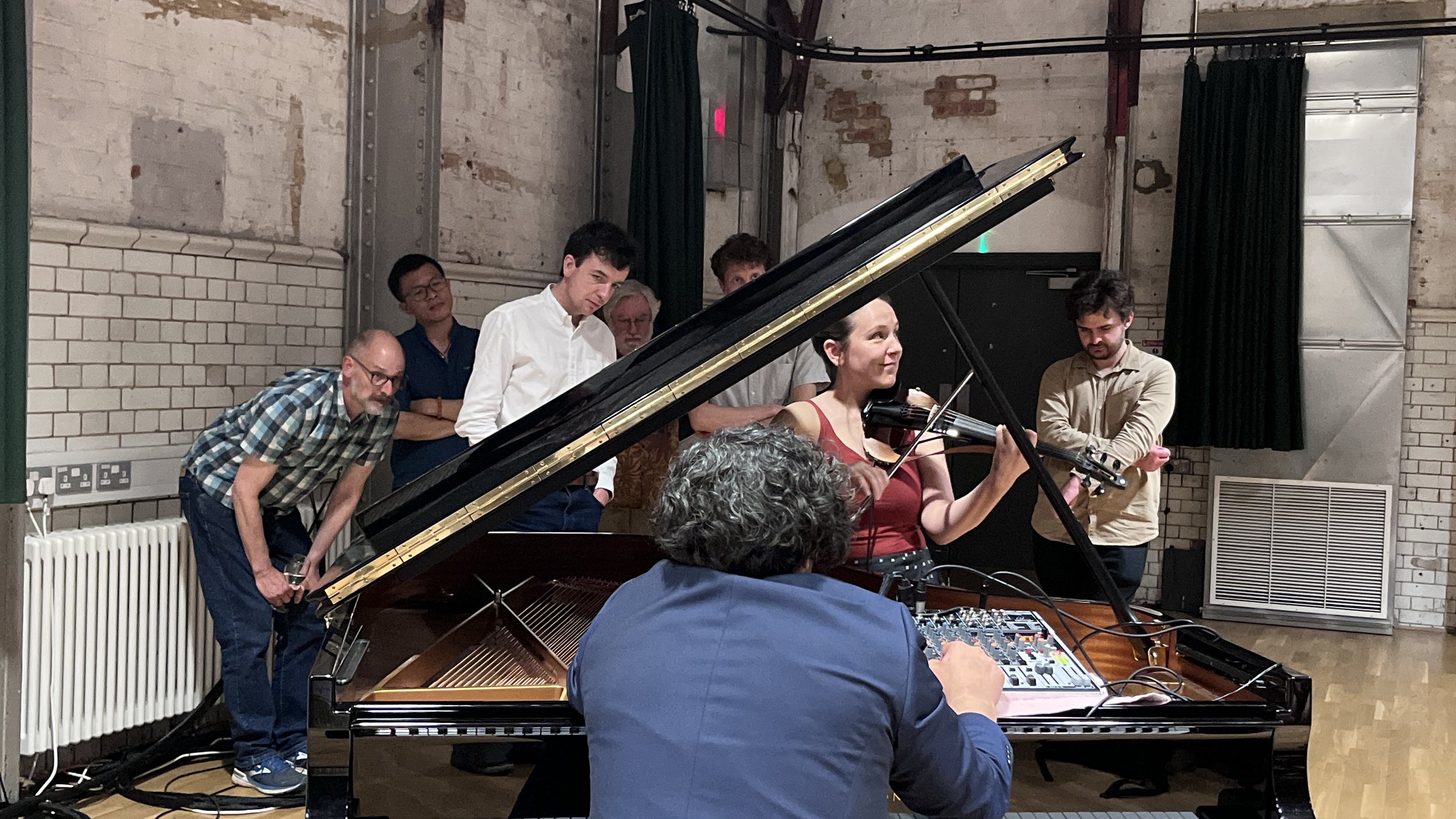
Zubin Kanga and Mira Benjamin performing we are environments for each other (trio) at our Music Ex Machina symposium on 16 June 2023.
Scott McLaughlin
we are environments for each other (trio)
Mira Benjamin - electric violin
Zubin Kanga - piano
In this trio, the third agent is the field of vibration that forms from the entangling of the violin and piano, since this is a complex system with its own emergent behaviours that can’t be reduced simply to the action of either the violin or the piano alone. The violin sound and the piano sound entangle to create the overall feedback system, with the two resonances interacting in complex ways. Both players work together to balance the drone and take advantage of emergent harmonies and resonances.
“In we are environments for each other (trio) Zubin uses doesn't play piano keys but the whole piece is played on the strings using a 'vibesware' electromagnetic resonator. The resonator device is similar to an EBow in that it causes the strings to ring and sustain through magnetic feedback loop, but it's much more powerful than the EBow (12v mains-powered) so it can activate any string on the piano (not just the middle register). Also, since it doesn't sit physically on the string, Zubin has much more performative control in terms of how close, or where on the string he directs the energy: Zubin also 'plays' the faders on the mixing desk to add/remove gain from himself or Mira's signals as required. Mira plays an electric violin which is amplified through the vibesware into the piano strings. Zubin's and Mira's respective sounds are mixed together to activate the piano string under the resonator. This creates a complex listening performance where it is often unclear which player's choices have most influence on the sound, it ends up being the piano strings themselves as the performative agent that often ends up "deciding" what pitch/timbre emerges.
In this piece, Zubin's relationship to the technology is very much hands-on and ears-on, requiring constant small shifts to gently explore the emergent possibilities in a field of resonant potentials. The technology itself is not complex, but the use-case emphasises the connectedness and relational performativity of the whole system. It's not simply the technology doing it's assigned task off-the-shelf: the resonator becomes an instrument that feeds a delicate system of complex vibrations, and the performance is in responding to that system, 'surfing' it.”
